Kino's Canoe
Kino's canoe is the single most valuable object he owns, a hand-built vessel that is at once property and source of food, the bulwark against starvation. It is very old, brought from Nayarit by Kino's grandfather, who gave it to Kino's father, and so it has come to Kino. Every year Kino refinished it with the hard shell-like plaster whose making is a secret method that also came to him from his father. When Kino comes to the beach, he touches the bow tenderly as he always does, a ritual of respect and continuity. The canoe is not merely a tool but a living inheritance, a tangible link to his ancestors and to the fishing people's way of life, preserved for generations by a waterproof plaster whose recipe is a guarded secret of the community.
The Canoe as the Center of Daily Life
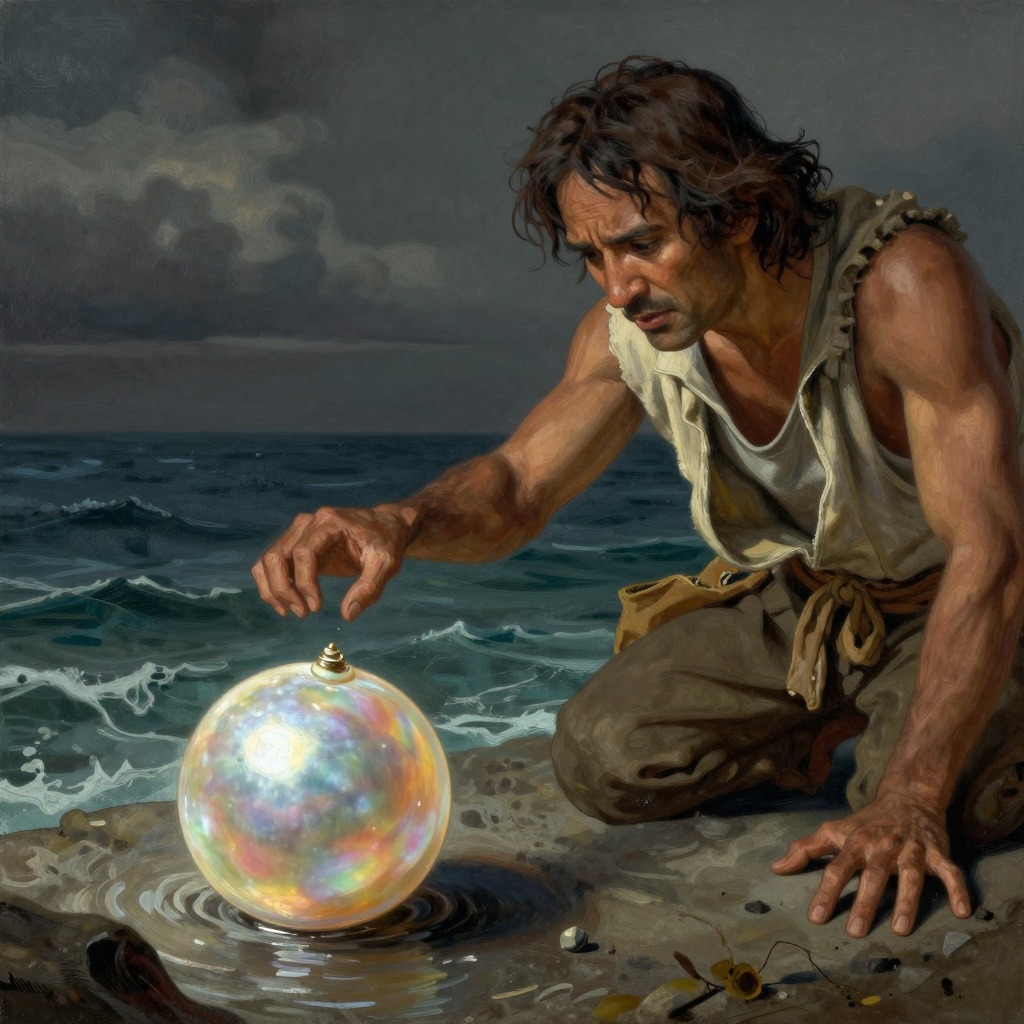
On the morning after the scorpion sting, Kino and Juana slide the canoe down the beach to the water. When the bow floats, Juana climbs in while Kino pushes the stern in and wades beside it until it floats lightly and trembles on the little breaking waves. Then in coordination they drive their double-bladed paddles into the sea, and the canoe creases the water and hisses with speed. This is the rhythm of their existence: the canoe is the means by which Kino provides for his family, the platform from which he dives for the oysters that may contain a pearl. In the canoe, Juana is like a strong man, her labor as essential as his. The canoe is the stage for the discovery of the great pearl itself: Kino lays the oyster in the bottom of the canoe, and there, squatting in the hull, he opens it to reveal the pearl "perfect as the moon." The canoe is thus the vessel not only of livelihood but of transformative fortune.
Destruction and the Severing of the Old World
After Kino kills a man in the second night attack, he stumbles toward the beach to prepare the canoe for flight. When the light breaks through again he sees that a great hole has been knocked in the bottom. A searing rage comes to him and gives him strength. The narrative makes explicit the enormity of this act: "This was an evil beyond thinking. The killing of a man was not so evil as the killing of a boat. For a boat does not have sons, and a boat cannot protect itself, and a wounded boat does not heal." The destruction of the canoe is the final, irreversible blow. Kino's house has been burned, a dead man lies in the brush, and now the canoe—the one thing of value he owned in the world, the inheritance from his grandfather and father—is shattered. Every escape is cut off. The canoe's destruction tightens Kino beyond breaking, reducing him to an animal state, living only to preserve himself and his family. It never occurs to him to take one of his neighbors' canoes, any more than he could conceive of breaking a boat himself; the taboo is absolute.
Narrative and Thematic Significance
The canoe functions as a material anchor for Kino's identity and his people's history. Its destruction is the culminating act of the forces arrayed against him—the pearl buyers, the trackers, the entire structure of a society that cheats the poor from birth to the overcharge on their coffins. The canoe's loss is more devastating than the killing of a man because it represents the destruction of a way of life, the severing of generational continuity, and the impossibility of return. When Kino and Juana return to La Paz with Coyotito's body, they walk past the burned square where their house had been without even looking at it, and they do not look toward Kino's broken canoe. The canoe, like the pearl, is a thing of the past, its ruin a permanent marker of all that has been lost. In the end, the canoe's absence is as eloquent as the pearl's return to the sea: both objects, one of labor and one of luck, are gone, and with them the possibility of the life they once sustained.